

To structure content for the Google AI Overviews feature, publishers must prioritize clear semantic hierarchies and concise factual declarations. Utilizing structured content for Google AI ensures that LLMs can accurately parse data points, listicles, and definitions to generate high-quality, synthesized search summaries for users.
The evolution of search synthesis requires a shift toward highly organized, machine-readable information. Google AI Overviews rely on a sophisticated understanding of web content to provide direct answers at the top of the search results page.
Success in this environment depends on how effectively a webpage communicates its core message to both humans and large language models. Content that lacks a logical flow or contains ambiguous phrasing often fails to be included in these AI-generated summaries.
Effective optimization focuses on the clarity of data and the predictability of document architecture. By following specific structural patterns, creators increase the likelihood that their information will be selected as a primary source for AI-driven responses.
The Role of Semantic Hierarchies in AI Synthesis
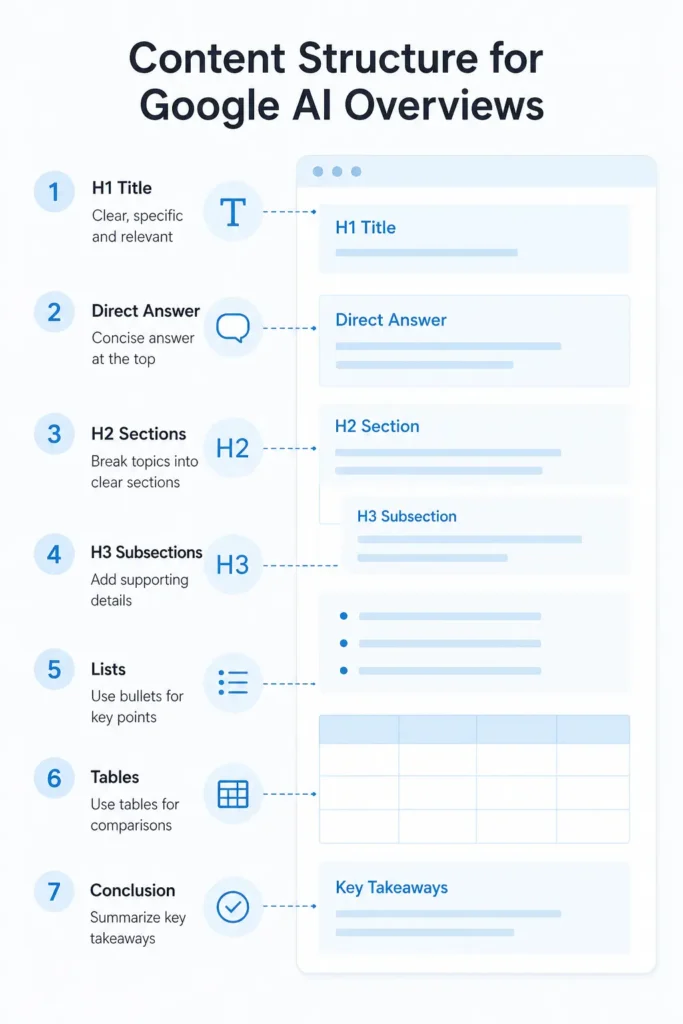
Search engines utilize header tags to build a conceptual map of a webpage. Proper use of H1, H2, and H3 tags provides a roadmap that allows AI agents to identify the relationship between different topics and subtopics.
A single H1 tag should represent the primary objective of the page, followed by H2 tags that break the topic into its fundamental components. This hierarchical approach prevents the AI from misinterpreting the context of specific sections.
Consistent header structures signal to the algorithm that the content is comprehensive and organized. When headers are phrased as common questions or clear noun phrases, the AI can more easily map them to user queries.
Optimizing Information Density for AI Extraction
Information density refers to the ratio of factual data to filler text within a paragraph. To optimize for AI Overviews, paragraphs should be brief and focused on delivering specific insights or definitions immediately.
Google’s generative AI systems prioritize “snackable” information that can be easily reformatted into bullet points or short summaries. Content that meanders or uses excessive fluff often gets discarded in favor of direct, authoritative statements.
The table below illustrates the difference between traditional narrative structures and those optimized for AI extraction.
| Element | Traditional Content | AI-Optimized Content |
| Paragraph Length | 5-7 sentences | 1-3 sentences |
| Sentence Structure | Complex/Compound | Simple/Declarative |
| Vocabulary | Metaphorical/Flowery | Precise/Technical |
| Formatting | Standard text blocks | Lists, Tables, and Headers |
Directness is the hallmark of AI-ready writing. By eliminating introductory filler, the core value of the content becomes more accessible to the LLMs responsible for generating search overviews.
Implementing Structured Data for Google AI
Structured data, specifically Schema.org markup, acts as a secondary layer of communication between the website and the search engine. While the visible text provides context, Schema provides a standardized format for data points.
Using structured content for Google AI helps define entities such as products, people, locations, and instructional steps. This technical layer reduces the margin of error for the AI when it attempts to synthesize complex information.
Common schema types that support AI overviews include the following:
- FAQ Page: Defines specific questions and answers for direct inclusion.
- HowTo: Outlines step-by-step processes with clear sequence markers.
- Product: Provides technical specifications, pricing, and availability.
When these technical signals align with the on-page text, the search engine gains higher confidence in the accuracy of the information. This confidence is a critical factor in whether a source is cited in an AI overview.
Utilizing Tables and Lists for Clarity
AI models excel at processing structured lists and tabular data because these formats isolate variables and values. Tables allow the AI to compare features or display data without needing to interpret complex prose.
Lists should be used whenever a sequence of items or a set of related facts is presented. Numbered lists are preferred for chronological steps, while bulleted lists work best for non-sequential features or tips.
The following table demonstrates how to categorize content types for maximum visibility.
| Content Type | Best Structural Format | AI Benefit |
| Processes | Numbered Lists | Ensures step-by-step accuracy |
| Comparisons | Data Tables | Allows for rapid attribute matching |
| Definitions | Bolded Sentences | Facilitates direct snippet extraction |
| Data Points | Bulleted Lists | Improves scannability for LLMs |
Each table or list should be preceded by a short introductory sentence. This provides the necessary context for the AI to understand exactly what the following data represents within the broader topic.
The Importance of the “Answer-First” Approach
The inverted pyramid style of writing is highly effective for modern search features. By placing the most critical information—the direct answer to the user’s intent—at the very beginning of a section, the content becomes “snippet-ready.”
AI Overviews are designed to save users time by providing answers without requiring a click. If a webpage buries the answer under a long introduction, the AI may find a more efficient source that provides the answer immediately.
Structure each section to follow a pattern of “Definition → Detail → Context.” This ensures that even if the AI only scrapes the first sentence, it still captures the essential fact required to satisfy the search query.
Fact-Density and Source Credibility
Google prioritizes content that demonstrates high levels of Experience, Expertise, Authoritativeness, and Trustworthiness (E-E-A-T). For AI Overviews, this translates to using verifiable facts and citing reputable sources.
Attributing data to specific studies or official organizations helps the AI verify the truthfulness of the content. Ambiguous claims or unverified opinions are less likely to be used in a synthesized response.
Maintain a neutral tone and avoid superlatives or subjective language. The AI is programmed to identify objective information; therefore, clinical and descriptive language usually performs better than persuasive or emotional copy.
Managing Content Length and Depth
While AI overviews are often short, the underlying source material must be deep enough to provide comprehensive context. A target of 1,500 to 2,000 words allows for an exhaustive treatment of a topic while maintaining high structural standards.
Each subtopic should be addressed in its own H2 or H3 section. This compartmentalization prevents the AI from confusing different aspects of the same subject.
The following list outlines the key attributes of comprehensive AI-friendly content:
- Exhaustive coverage of the primary keyword and related terms.
- Logical progression from general concepts to specific details.
- Inclusion of expert quotes or industry-standard definitions.
- Integration of high-quality visual aids with descriptive alt text.
Technical Considerations for Content Visibility
Beyond the writing itself, the technical health of the website influences how AI crawlers interact with the content. Slow load times or intrusive pop-ups can hinder the ability of the engine to index the structure properly.
Ensure that the mobile version of the site is clean and easy to navigate. Since Google uses mobile-first indexing, the structural integrity of the mobile page is what the AI will ultimately evaluate for its overviews.
Text should be easily readable against the background, and all navigational elements should be clearly defined. A clean, minimalist design often correlates with better content parsing by search algorithms.
The Final Structure:
Adapting to Evolving Search Intent
Search intent is the underlying reason a user performs a query. AI Overviews are particularly active for “informational” and “how-to” queries where a quick summary is beneficial.
Content must be structured to meet these specific intents. For a “how-to” query, the structure should focus on sequential logic. For a “what is” query, the structure should focus on a concise, bolded definition followed by relevant characteristics.
Understanding the nuances of how to structure content for Google AI Overviews feature requires constant monitoring of SERP patterns. As the AI becomes more sophisticated, it will likely favor content that integrates multiple formats—text, video, and data—into a single cohesive experience.
Conclusion
Successful content architecture for the AI era is defined by transparency and organization. By prioritizing semantic headers, structured data, and high information density, publishers can align their assets with the requirements of Google’s generative search features.
The transition toward AI-driven results does not devalue long-form content; rather, it demands that such content be better organized. Those who master the art of structured content for Google AI will remain visible in an increasingly automated search landscape.