

Paid advertising works until it stops. The moment a campaign pauses, the traffic disappears with it, and everything built around that visibility resets. For businesses that want something more dependable, organic search tends to behave differently.
Rankings that are earned through consistent SEO work do not switch off when a budget runs dry. They hold. They compound. A page that reaches the first page of Google for a relevant term keeps attracting visitors month after month, often long after the initial work was done. That durability is what makes organic search a different kind of investment compared to channels that require constant spending to stay active.
An organic SEO agency handles that process for businesses that want a consistent search presence without depending on ad spend. If you are weighing your options, reach out to Klubz Media to see what that looks like for your specific situation.
This guide covers what these agencies actually do, what realistic pricing looks like, and how to evaluate one before signing anything.
What Is an Organic SEO Agency?
An organic SEO agency is a service provider that helps websites rank higher in search engine results without paid advertising. The work involves a mix of technical fixes, content development, keyword targeting, and link acquisition, all designed to make a site more relevant and trustworthy in Google’s eyes.
A local home services company, for instance, might work with an organic SEO marketing agency to rank for terms like “plumber near me” or “HVAC repair Austin,” generating steady inbound calls without touching a single ad account. The agency manages the strategy, the execution, and the tracking.
How Organic SEO Differs From Paid Search
The distinction matters more than most people expect when they are first budgeting for search visibility.
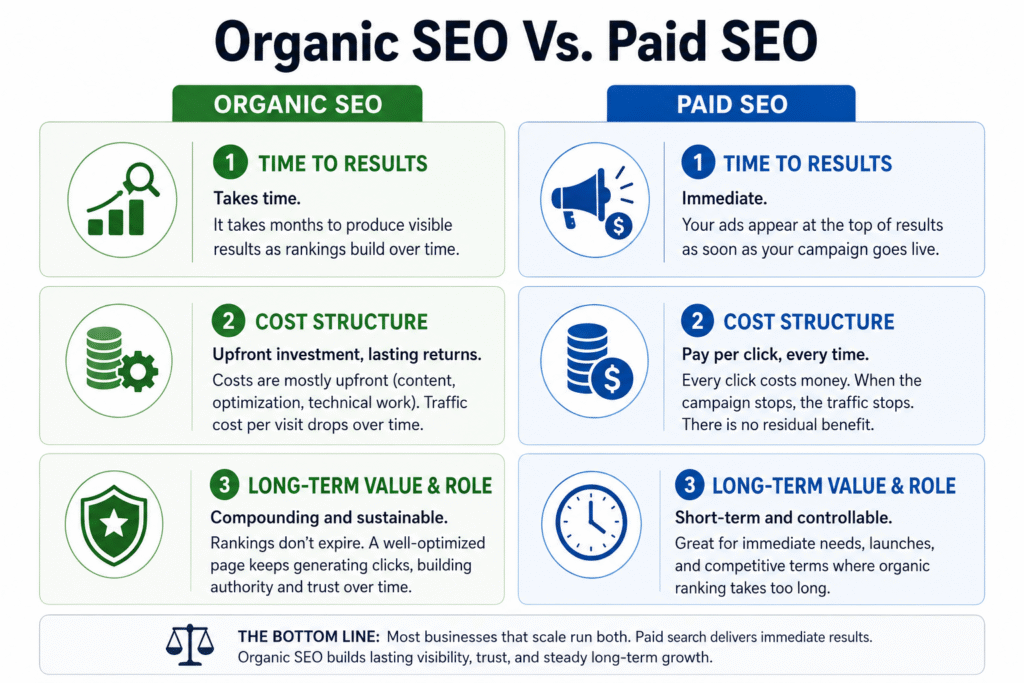
Paid search, typically Google Ads, puts your pages at the top of results immediately. You bid on keywords, set a budget, and traffic starts arriving. It works, and for businesses that need volume quickly, it has real value. But the model has a ceiling. Every click costs money, and the moment the campaign stops, so does the traffic. There is no residual benefit. Nothing carries over.
Organic SEO operates on a different timeline and a different cost structure. The work takes months to produce visible results, but the rankings that develop from it do not expire when a payment lapses. A well-optimized page earning position three for a relevant search term keeps generating clicks whether or not anyone is actively working on it that month. The traffic cost per visit drops over time as the investment stays fixed and the returns grow.
Most businesses that reach a certain scale end up running both. Paid search covers immediate gaps, product launches, or highly competitive terms where organic ranking takes too long. Organic SEO handles the longer tail, the steady volume, and the search terms where trust and authority tend to matter more to the user clicking through.
What Services Do Organic SEO Agencies Provide?
The scope of work at a typical organic SEO agency covers several interconnected areas. No single tactic does the job alone. Agencies bring together technical expertise, content production, and off-site authority building into a coordinated campaign.
Here is a breakdown of what that usually looks like in practice.
Technical SEO Audits
Before any optimization begins, agencies audit the site’s technical foundation. This includes crawlability, indexing status, site speed, mobile usability, Core Web Vitals, and internal linking structure. The goal is to identify anything that prevents Google from properly reading and ranking the site. Issues found here often have an outsized impact on performance, and fixing them creates a cleaner foundation for everything else.
Keyword Research and Search Intent Mapping
Agencies spend significant time identifying which search terms matter most for a business. This goes beyond finding high-volume keywords. The focus is on understanding intent, meaning whether someone is searching to learn, compare, or buy. According to research published by Ahrefs, the top result in Google gets roughly 27.6% of all clicks for a given keyword, which makes ranking for the right terms a meaningful commercial decision.
On-Page Optimization
Once the right keywords are identified, agencies optimize individual pages to reflect those terms naturally. This includes title tags, meta descriptions, heading structure, internal links, image alt text, and the actual content itself. The aim is to make each page as clear and relevant as possible to both search engines and readers.
Content Strategy and Production
Most organic SEO campaigns involve an ongoing content plan. Agencies either produce content directly or guide an in-house team on what to create. Topics are chosen based on keyword opportunity, competitive gaps, and business relevance. Content types vary, including blog posts, service pages, comparison pages, and FAQ sections, depending on what the audience is actually searching for.
Link Building and Digital PR
Backlinks remain one of the more significant ranking signals Google uses. Agencies build these through editorial outreach, digital PR campaigns, guest contributions, and sometimes resource-based link acquisition. The quality and relevance of the linking sites matters considerably. A few links from well-established, topically related domains tend to carry far more weight than dozens of low-authority ones.
Local SEO (Where Applicable)
For businesses serving specific geographic areas, a local SEO agency focuses on optimizing Google Business Profiles, local citations, and geo-targeted content. This helps a business appear in map results and local pack listings, which often capture users who are ready to act.
Reporting and Performance Tracking
Reputable agencies send monthly reports covering organic traffic trends, keyword movement, conversions attributed to organic search, and any technical issues addressed. Most use tools like Google Search Console, Ahrefs, or SEMrush to track this data. A good report should be readable without needing an SEO background to understand it.
How Much Do Organic SEO Agencies Charge?
Pricing at an organic SEO agency depends on a few key factors: the size of the website, the competitiveness of the target keywords, the scope of deliverables, and the structure of the agency itself. Boutique agencies that handle fewer clients typically charge differently than large full-service operations with dedicated account teams.
Businesses should also consider outsourcing models, particularly white-label agencies or offshore teams, which can offer full-service SEO at a fraction of the cost of US or UK-based firms without meaningful drops in output quality.
The table below gives a general sense of pricing across different markets. Rates vary even within these ranges based on deliverables included and contract length.
| Country | Average Monthly Pricing | Typical Services Included |
| United States | $1,500 – $5,000+ | Full audit, keyword research, content, link building, reporting |
| United Kingdom | $1,200 – $4,000+ | Technical SEO, content strategy, outreach, monthly reporting |
| Australia | $1,000 – $3,500+ | On-page, content, local SEO, backlink acquisition |
| Bangladesh | $200 – $800 | Keyword research, on-page, content production, basic link building |
| Global White-Label / Outsourced | $300 – $1,200 | Full-service execution under agency branding |
According to data compiled by Backlinko, the average monthly retainer for SEO services in North America falls between $500 and $5,000, with mid-market campaigns commonly running around $1,500 to $2,500 per month. Project-based and hourly pricing also exist, though retainers are the most common model for ongoing campaigns.
Monthly Retainer Model
The most common arrangement. The agency handles an agreed scope of work each month, covering everything from content to link building, and reports on results regularly. Retainers suit businesses that want ongoing management without having to hire in-house.
Project-Based Pricing
Some agencies offer fixed-scope projects, such as a technical audit with a list of recommendations, or a one-time content build-out for a new service area. These are typically one-time engagements. They work well for businesses that want a clear deliverable without committing to a long-term contract.
Performance-Based Pricing
Less common, but some agencies tie part of their fee to specific outcomes like ranking improvements or traffic increases. These arrangements can look attractive upfront, but they often come with terms that favor the agency, such as targeting lower-competition keywords to hit benchmarks more easily. Worth reading carefully before signing.
How to Hire an Organic SEO Agency
Finding the right, best organic SEO agency is less about finding the flashiest pitch and more about asking the right questions during evaluation. Here are five practical steps.
1. Define your goals first
Know what outcome matters most, whether that is traffic volume, lead quality, local visibility, or national keyword rankings. Agencies that ask about your goals before quoting a plan are usually more reliable than those who skip straight to deliverables.
2. Review case studies and verified results
Ask to see examples from businesses similar to yours in size or industry. Real results with documented timelines are a better indicator than awards or client logos on a homepage.
3. Ask about communication and reporting cadence
Find out who the point of contact will be, how often they send updates, and what the reports actually include. Monthly check-ins, clear ownership of tasks, and consistent reporting are signs of a well-run agency.
4. Understand the deliverables clearly
Get specifics in writing: how many pieces of content per month, how many links, what the audit covers, and what the timeline looks like for each phase. Vague deliverables lead to vague results.
5. Check their approach to white-hat practices
Any agency that promises top rankings within 30 days or offers “guaranteed results” should be approached with caution. Organic SEO takes time, and shortcuts tend to create problems that take longer to fix than the original work.
What to Expect From an Organic SEO Agency
Hiring an organic SEO agency means investing in a process that builds over time, not a switch that flips on ranking overnight. Most businesses see meaningful movement between the third and sixth month, with more substantial results becoming visible around the 9 to 12-month mark. Competitive industries or newer domains may take longer.
Here is what the working relationship typically involves:
- Onboarding period (weeks 1–4): Site audit, keyword research, competitor analysis, and strategy development. Not much has changed visibly on the site yet, but the foundation is being set.
- Implementation phase (months 2–4): Technical fixes go live, content begins publishing, and outreach for links starts. Small ranking movements may appear for lower-competition terms.
- Growth phase (months 5–12): Traffic begins compounding as content gains authority and more pages rank. This is where the investment starts to return measurable results.
- Ongoing optimization: Agencies revisit content, track keyword shifts, monitor algorithm updates, and adjust the strategy accordingly. SEO is not a one-and-done activity.
- Monthly reporting: Expect a written report covering organic sessions, keyword positions, conversions, and a summary of work completed. Good agencies also note what they plan to focus on next month.
- Communication: Most agencies offer email and a monthly call. Some include Slack or project management access so clients can track tasks in real time.
How to Tell If an Organic SEO Agency Is Actually Doing Good Work
Results take time in organic search, which makes it genuinely difficult to evaluate an agency during the first few months. A few things tend to separate agencies that are building something real from those that are producing activity without direction.
Keyword targeting
An agency that only chases high-volume terms without accounting for competition or intent is usually optimizing for the appearance of progress rather than actual outcomes. Meaningful campaigns tend to mix quick-win opportunities, mid-range targets, and longer-term priority terms, and the rationale for that mix should be explainable.
Content quality
Pages that read like they were written to satisfy a keyword count rather than to answer a question tend to rank briefly if at all. Well-run agencies produce content that covers a topic in a way that is actually useful to the person who searched for it. That is not subjective. You can usually tell by reading it.
Backlink transparency
Ask the agency to show you where links are being placed, on which domains, and why those domains were targeted. Agencies doing legitimate outreach will have straightforward answers. Vague responses about “link networks” or “high DA placements” without specifics are worth pressing on.
Finally, the reporting itself tells you something. Monthly reports that only show traffic going up without explaining why, or reports that focus heavily on vanity metrics like impressions without tying anything to conversions, usually reflect a lack of genuine accountability.
Industries That Tend to See Strong Returns From Organic SEO
Organic search performs differently across industries, and understanding where it tends to deliver the clearest return helps businesses decide how much weight to put on it relative to other channels.
Service businesses with defined geographic coverage, think legal practices, home services, medical clinics, and accounting firms, often see strong results because local search intent is high and conversion rates for those queries are meaningful. Someone searching “family lawyer [city]” is not browsing casually.
E-commerce businesses benefit considerably from product and category page optimization, particularly for brands that carry products with genuine search demand. Ranking a product page for a specific, high-intent search term can drive consistent revenue without a paid placement cost attached to each transaction.
B2B companies with longer sales cycles tend to find that content-driven organic SEO builds pipelines in ways that are harder to attribute but consistently valuable. A decision-maker who finds a company through an informational article, returns a few times, and eventually requests a demo represents a conversion path that paid search rarely captures efficiently. B2B SE O agencies often keep organic as their main focus.
Industries with very short decision windows, such as emergency services or same-day delivery, typically rely more on paid channels for immediate visibility. Organic SEO still plays a supporting role, but it is rarely the primary driver in those cases.
FAQ
How long does it take to see results from an organic SEO agency?
Most businesses begin to see early movement, such as improved rankings for lower-competition keywords, within three to four months. Significant results, including consistent traffic increases and rankings for primary terms, generally come between six and twelve months. The timeline depends on the site’s current state, the competitiveness of the industry, and how consistently the agency executes the strategy. Organic SEO compounds over time, meaning patience is part of the process.
Is an organic SEO agency still worth it?
Yes, for most businesses that rely on search traffic. Paid advertising stops generating traffic the moment campaigns are paused. Organic rankings, once earned, tend to hold and continue producing visitors without ongoing spend per click. For businesses thinking about long-term customer acquisition, an organic SEO marketing agency often delivers a better return over 12 to 24 months compared to channels that require constant budget input to stay active. So, this clarifies that organic SEO is still worth it.
What is the most affordable organic SEO agency?
Pricing varies widely, so “affordable” depends on scope and expectations. Some agencies offer service-based pricing where clients pay for specific deliverables rather than a flat retainer, which helps smaller businesses manage costs. Klubz Media, for example, offers organic SEO services starting at $50, structured around specific services rather than a one-size-fits-all package. This makes it accessible for businesses that need focused help with keyword research, on-page optimization, or content without committing to a full monthly retainer right away.